
A Note on Duchamp

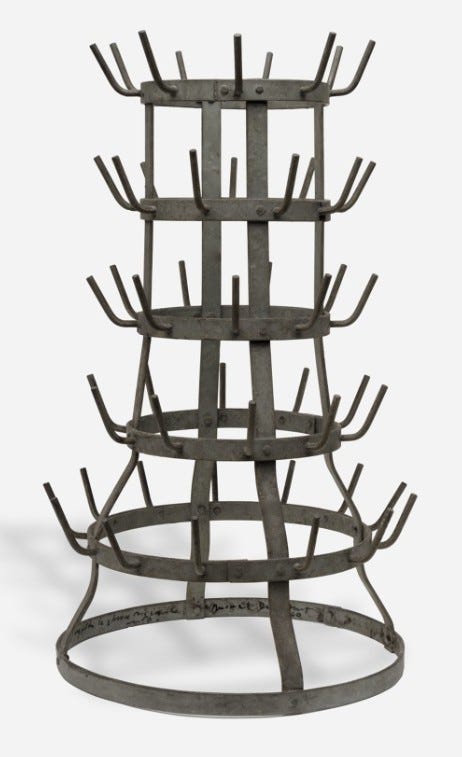
Robert Morris once told me about a panel discussion he attended at the Museum of Modern Art. The panelists were William Rubin, art historian and head of the Museum’s Department of Painting and Sculpture; Alfed H. Barr, Jr., the visionary director who shaped the Museum’s collection; and Marcel Duchamp. In the hope of nailing down Duchamp’s place in art history, Rubin tried to get him to identify the formal precedents of Bicycle Wheel, 1913, and the other readymades. Duchamp dashed this hope with one graceful evasion after the next. The discussion went back and forth, going nowhere, when Barr suddenly said, “But Marcel, why are the readymades so beautiful?” Duchamp said, “Nobody’s perfect.”
I know that a play of wit is better left to shimmer untouched, but I can’t help subjecting this one to a bit of interpretation. To begin with the obvious question: what made the beauty of the readymades an imperfection? The answer: Duchamp’s iconoclasm. The targeted icon was the traditional figure of the artist as a creative genius, which Duchamp did not so much assault as subvert. Does the creativity of these geniuses produce original objects and images? The Bicycle Wheel, the Bottle Rack, 1914, and the other readymades are mass-produced objects and therefore seen as unoriginal. Are the works of creative geniuses expressive? The readymades, it seems, are adamantly inexpressive. Do creative geniuses give us flickering glimpses of their innermost beings? The readymades offer no obvious clues to the hidden Duchamp. Finally, do creative geniuses bring beauty into the world? Yes, many do, and so the beauty that Barr saw in the readymades was a sign that Duchamp’s iconoclasm was not thoroughgoing. It left the most salient quality of traditional art unscathed. Hence his confession that he wasn’t perfect. This, however, was a false confession and Duchamp only appeared to subvert the images of the creative genius. In fact, he gave the image new life.
In 1912 Duchamp visited a Parisian aircraft exposition with the sculptor Constantin Brancusi. As they contemplated a propeller, Duchamp said, “Painting is over. Who could do better than this propeller? Could you do that?” Brancusi’s response is not on record, though he may well have agreed with Duchamp that the form of the object in question had clarity, unity, grace, and therefore beauty. Admiration for the look of mass-produced machinery was not new in 1912. On his 1882 tour of America, Oscar Wilde delivered a lecture entitled “Art and the Handicraftman,” which turns on the observation that “people often talk as if there was an opposition between what is beautiful and what is useful. There is no opposition to beauty except ugliness … utility will be always on the side of the beautiful thing.” Thus “we cannot but think all good machinery is graceful … the line of strength and the line of beauty being one.” If we kept an eye out for it, we could probably discover a machine that works well but is not especially beautiful. Still. it’s not difficult to find machines and gadgets that combine beauty with functionality. See the Bottle Rack, an object whose mixture of simplicity and complexity never grows stale.
All the readymades possess a measure of beauty. Duchamp, after all, had good taste. So what do you believe? His iconoclastic pronouncements or your own eyes? He said he wanted to subvert traditional ideas of art and the artist, yet his readymades are as beautiful in their various ways as Brancusi’s sculptures or Impressionist landscapes. Nor are Bottle Rack, Bicycle Wheel, and the others entirely inexpressive. They testify to Duchamp’s love of beauty and display the wit that sparked his originality, which is notable but not absolute. In 1912, Georges Braque or possibly Pablo Picasso invented the two-dimensional readymade when he pasted bits of newsprint and wallpaper to his paintings. Duchamp was the first to deploy this tactic in three dimensions. What he did, then, was to make works that were original, expressive, and beautiful: characteristics to which traditional works of art had long aspired. Far from undermining inherited ideas about art, he found ways to preserve that inheritance without employing the usual skills. This, too, was original.
Duchamp never objected when his admirers called him the one-man wrecking crew who demolished the very foundations of art. Yet his traditional virtues—his originality, his expressiveness, his devotion to beauty—are on the surface of his work, easily detected, and they earned him a prominent place in the history he supposedly upended. If he had been truly radical, curators, critics, and collectors would have relegated his works to the darkness beyond the boundaries of art. Instead, they praised him for posing a threat he never truly posed and enjoyed his variations on familiar aesthetic values. To play the part of a radical while offering the reassurance of tradition—that took real wit.
"If he had been truly radical, curators, critics, and collectors would have relegated his works to the darkness beyond the boundaries of art."
However, when 'Fountain' was exhibited for the first time, it was largely ignored.
It took some time for Duchamp's readymades to be accepted as art, and in order for readymades to be accepted as art, yes, Duchamp cannily deployed his good taste and aesthetic genius (so to speak), even if that meant recognizing and transmitting the beauty of ostensibly non-art things.
Duchamp remarked: "Can one make works that are not 'of art."
The question is what he meant by "works" in this sentence.
Did he mean artworks?
Or things or objects that constitute a different condition of being in the world?
Something at once art and not-art?
It is the fact that we still ask these sorts of questions - and that these aesthetic ambiguities remain - that makes Duchamp an enduring "radical."
When Ed Ruscha was looking over his photographs during a retrospsective at the Whitney, he is reputed to have said, "I did my best not to make anything artistic about my photographs, but now that I see them up all together, darned if they aren't art."