
Remembering Robert Mnuchin

Robert Mnuchin opened his gallery in 1993 with a Willem de Kooning exhibition. Entitled “Transcending Landscape,” it presented a large selection of paintings from the mid- to late 1970s that evoke, in addition to landscape, the human figure. Of course, the overriding subject of these elegantly smeared images is the artist’s presence: commanding and yet tinged by panic. De Kooning never dispensed with that old Abstract Expressionist idea: to launch a painting is to confront a crisis. The gallery’s last show was a retrospective of Julian Schnabel’s plate paintings, which closed in January of this year. Mnuchin died the previous December at the age of ninety-two.
He organized three Schnabel exhibitions and twelve devoted to de Kooning. After the inaugural show came “Drip Paintings on Paper,” an extensive selection of small, allover paintings by Jackson Pollock. I wrote an essay for that exhibition’s catalog and, much later, I contributed essays to the catalogs of “Homage to Frank Stella,” a commemoration of the artist’s long career, and “Franz Kline,” the gallery’s next to last show. Though I never got to know Robert Mnuchin well, my dealings with him were always congenial. Over the decades I came to admire his way of running a gallery, which deserves to be remembered not only because it was unique but also because it produced such a remarkable sequence of major exhibitions.
Most galleries have a roster, a group of artists contractually bound to show their work at that venue— primarily if not exclusively. Mnuchin had no roster. He began every exhibition with a blank slate, borrowing works from institutions and fellow collectors and filling in gaps with works from his own collection and the gallery’s inventory. Often there were just a few—sometimes only one—painting or sculpture for sale. Profit was not Mnuchin’s primary motive. Barnett Newman once said that he wrote so that he would have something to read and painted so he’d have something to see. Mnuchin presented an artist’s work because he believed it was important and he wanted to see it in depth. Profoundly acquainted with twentieth-century art, he had an unending need to know more. And he wanted the rest of us to know more. If a show led to sales, that was all for the good. Yet he was mainly concerned with the revelations provided by arrays of significant, well-selected works of art.
Few if any other galleries followed Mnuchin’s model, made possible by his success as head of trading and arbitrage at Goldman Sachs. Retiring in 1990, he opened his gallery three years later in partnership with James Cochran. Mnuchin then partnered with Dominique Lévy, until 2013. At every stage of his art world career, he functioned not as a traditional dealer so much as an art lover who opened a gallery because he wanted to extend his enthusiasms beyond the bounds of his private collection. The Mnuchin Gallery was a business enterprise, of course, yet its exhibitions always had a further mission: to focus the art world’s attention and expand its imagination.
“Black, White and Gray,” the show of Minimalist and conceptual art Samuel Wagstaff organized for the Wadsworth Atheneum in 1964, made the case for restraint. Abstract Expressionism was out, impersonality was in. More than four decades later, the Mnuchin Gallery offered a rebuttal—“Beyond Black, White and Grey,” 2009. Including by-then historical figures from the earlier show (Agnes Martin, Dan Flavin), this exhibition added younger artists (Günther Uecker, Damien Hirst, David Hammons). An accompanying statement noted that “reductive art can be quite expressive. Which leads to the clichéd, yet appropriate question—maybe things are not so black and white?” Maybe, as this and every other Mnuchin show suggested, nothing in art is ever settled. For its meanings are inexhaustible and revisitations are always advisable.
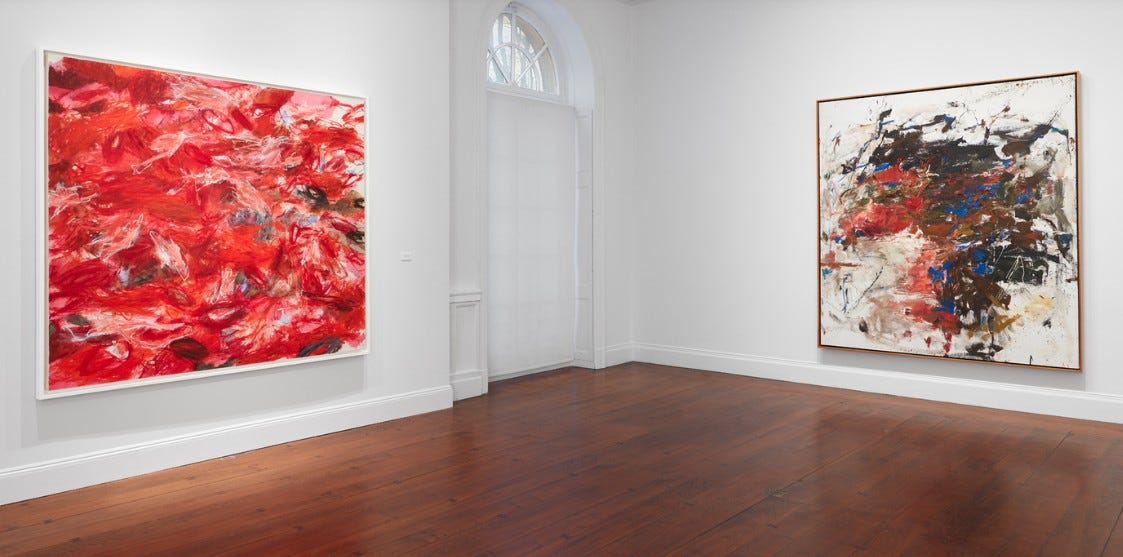
Mnuchin presented three David Hammons exhibitions, among them a survey of five decades of work. There were six Warhol shows, and one of the three containing works by Picasso confronted his portraits of Dora Maar with de Kooning’s Woman paintings. Mnuchin loved juxtapositions. In 2017, he exhibited de Kooning’s painterly fragmentations alongside their sculptural equivalent in sculptures by John Chamberlain. A few years later, he introduced the New York audience to Christine Ay Tjoe, an abstract painter from Indonesia, in the company of Joan Mitchell. And “The Art of Marriage” mixed paintings by Helen Frankenthaler with those of her husband, Robert Motherwell. Mnuchin’s sole venture beyond the boundaries of modern art was “Church and Rothko: The Sublime,” which revealed remarkable affinities between Rothko’s Abstract Expressionism and Hudson River School landscapes by Frederic Edwin Church. Juxtapositions like these always afforded illuminating contexts, and a large, ever-expanding perspective emerged from the succession of Mnuchin Gallery exhibitions over the years.
Neither the “Homage to Frank Stella” nor Mnuchin’s last Franz Kline show was a response to art world buzz. Both painters had in recent years been consigned to the margins of critical and curatorial attention. Mnuchin could not have cared less, for he was convinced, rightly so, that Stella and Kline are important painters and thus worthy of attention wherever fashion might be aiming its gaze. Mnuchin’s passionate dedication to art led him to unshakable convictions and something more—a view of art history as courageous as it was comprehensive.
A lovely tribute to someone who saw the art world as a place of true dialogue.
My favorite snippet:
“At every stage of his art world career, he functioned not as a traditional dealer so much as an art lover who opened a gallery because he wanted to extend his enthusiasms beyond the bounds of his private collection.”