
Why Write About Art?

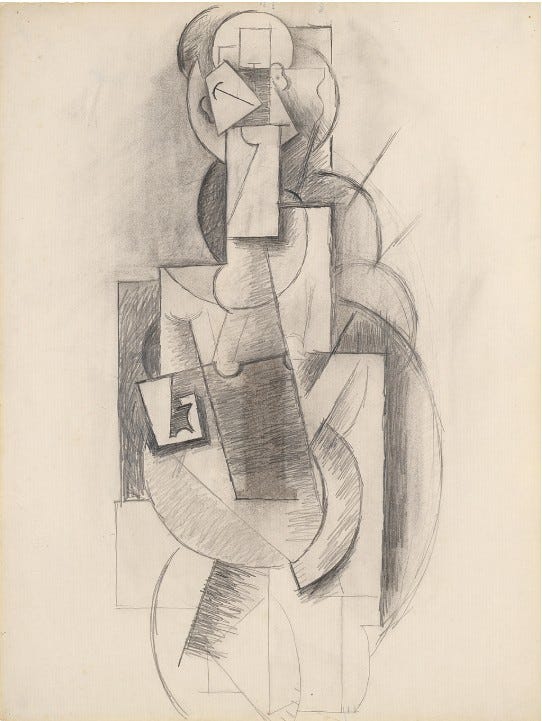
In a comment on one of my recent posts, a reader said that to interpret a painting can feel tyrannical—an imposition of language on a work that is, of course, visual. I agree and would like to add that it can feel tyrannical to impose interpretive language on an artwork in any medium, including language. Or sound, as in a musical composition. Or it can be a mistake. In “What Metaphors Mean,” an essay from 1978, the philosopher Donald Davidson wrote:
If someone draws a finger along a coastline on a map, or mentions the beauty and deftness of a line in a Picasso etching, how many things are drawn to your attention? You might list a great many, but you could not finish since the idea of finishing would have no clear application. How many facts or propositions are conveyed by a photograph? None, an infinity, or one great unstatable fact? Bad question. A picture is not worth a thousand words, or any other number. Words are the wrong currency to exchange for a picture.
Words are the wrong currency if you use them to state a proposition or assert a truth about the meaning of a visual image—provided that the image is a work of art, because the meanings of the images that count as art are not paraphrasable. They cannot be translated into language. An illustration or piece of propaganda asserts something, truthfully or not. A documentary image is accurate or misleading. And what about the map Davidson mentions? If we see it as a navigational tool, the map joins documentary images in the category of visual things that do or do not convey reliable information. But if, like Davidson, we group the map with a drawing by Picasso the question of accuracy falls away and we are no longer interested in information. We are interested in—what, exactly? If I say, as I often do, that we are interested in the meanings of artworks, the question is still unanswered, because, as I said just a moment ago, it is not possible to transpose those meanings from a visual medium into a set of verifiable statements.
The impossibility of answering the question produces frustration, an unpleasant feeling that leads us into the temptation of presuming to nail down the true meaning of an artwork with an authoritative sounding statement. But a statement of that kind betrays the work, which by its nature is beyond the reach of true-or-false statements about meaning. Still, there is a degree of satisfaction in saying something that makes ordinary sense, however tyrannical the pronouncement may be—however ruthlessly it ignores our experience of the work in favor of sounding certain about its meaning and its value. To strike a pose of certainty brings a satisfaction difficult to resist, for we don’t want to get all dreamy and poetic, like the stereotype of an Artnews reviewer from the 1950s. Or do we?
What, after all, are the alternatives? We could revive the certainties of old-fashioned formalism, which offered ironclad certainties about the essence of painting and course of the medium’s history. We could imitate the art theorists who politicized formalism and thus turned it into a machine for producing dogmatic declarations about the relationship of art and society, not to mention late capitalism. These are not happy options. To believe in the formalists’ essence of painting you must be naïve enough to buy into the bush-league Platonism Clement Greenberg extracted from the teachings of Hans Hofmann in the 1940s. To play at art theory you have to be as silly as Benjamin Buchloh, who brought a tendentious syllogism to bear on the art of Andy Warhol. Here is the syllogism:
Important artists offer a critique of fine-art traditions and of the markets that sustain those traditions.
Andy Warhol is an important artist.
Therefore, Andy Warhol offers a critique of fine-art traditions and of the markets that sustain those traditions.
Interviewing Warhol in 1985, Buchloh tries to badger him into acknowledging the the syllogism’s truth. What else could be the significance of his commercial imagery and his use of such low-art mediums as silk-screening and that sparkle known as diamond dust? Warhol blithely resists Buchloh’s agenda, hinting along the way that his interlocutor strikes him as hopelessly dense. He agrees that certain conceptual artists are interesting but, to Buchloh’s dismay, he also praises such modernist warhorses as Josef Albers and “the kids” who have backslid into figure painting. Buchloh does his best to pretend he is not hearing all the stuff that doesn’t support his theory.
No one pays much attention these days to art theorists or Greenbergians, yet the rhetoric of workaday art criticism still comforts readers with the illusion of having learned something true about the meaning of this or that work of art. The thing is this: truth is not the point. We go to works of art because, as William Blake says, they “rouze the faculties to act.” They set the imagination in motion. And so our talk about an artwork is anything but tyrannical when it inspires us to speculate about meaning, when it prompts us to be aware of our feelings about the work, and when it encourages memory to infiltrate the present in which we join this and every other work of art.
The best art writing attempts to interpret the context, rather than translate the ineffable.
For every reason, any reason , or no reason at all, just keep writing !
All the artistic disciplines need to be socialized, by entering the social sphere and then the Arts need finance to continue and flourish. Critical writing, appreciation forums, and discussions of all types work together to appreciate the Arts. Usually, writiungs trigger finance too. Invaluable .
The closed off dictatorial theoreticians bored their audience and finally bored themselves too.
Opening the exchange of meanings and inspirations is wonderful . Thanks for this.